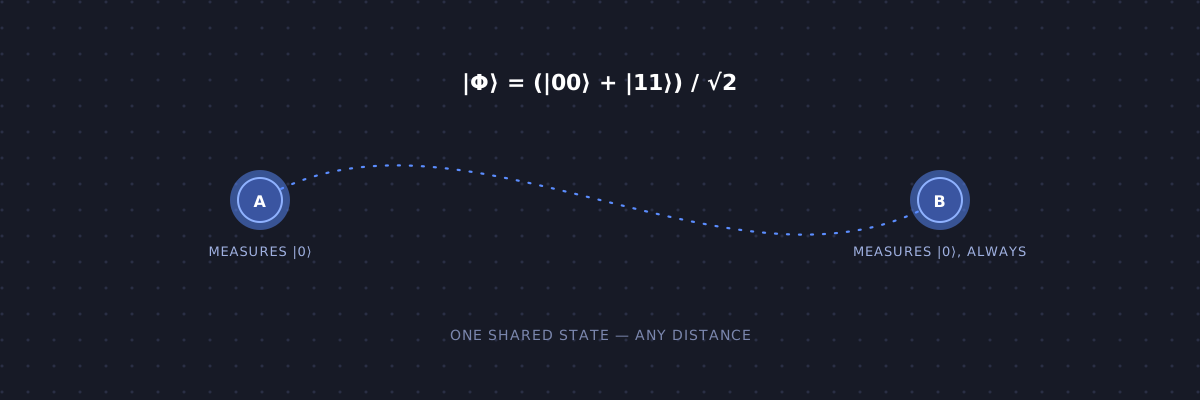
Every post in this series has been building toward this one. State vectors gave us the object. Hadamard gave us superposition. The Pauli gates gave us the operators that describe every possible error. The two-gate circuit — Hadamard then CNOT — gave us a concrete recipe for the strangest, most argued-about phenomenon in the field: entanglement.
The Four Bell States
Bell states are the four maximally entangled two-qubit states, named for physicist John Stewart Bell. Every one of them can be built by the H-then-CNOT circuit from the previous post, with a small variation in the input:
|Φ⁺⟩ = (|00⟩ + |11⟩) / √2
|Φ⁻⟩ = (|00⟩ − |11⟩) / √2
|Ψ⁺⟩ = (|01⟩ + |10⟩) / √2
|Ψ⁻⟩ = (|01⟩ − |10⟩) / √2
Take |Φ⁺⟩ and read what it says: this two-qubit system has exactly a 50% chance of being measured as 00 and a 50% chance of being measured as 11. There is no 01 or 10 term at all — those outcomes have zero amplitude, not low probability, but exactly zero. Measure the first qubit and get 0? The second qubit is now, with certainty, also going to read 0. Get 1? The second is now certainly 1. This holds no matter how the two qubits are measured, in what order, or how far apart they are.
| State | Correlation |
|---|---|
|Φ⁺⟩ | Always equal outcomes (00 or 11) |
|Φ⁻⟩ | Always equal outcomes; opposite relative phase |
|Ψ⁺⟩ | Always opposite outcomes (01 or 10) |
|Ψ⁻⟩ | Always opposite outcomes; opposite relative phase |
Why This Isn't Just a Correlated Coin
The obvious objection: isn't this just like mailing two friends one sealed envelope each from a pair that's secretly red-red or blue-blue? They open their envelopes thousands of miles apart and find matching colors, but nothing strange happened — the colors were fixed the moment the envelopes were sealed. This is called a local hidden variable explanation, and it's exactly what Einstein, Podolsky, and Rosen proposed in 1935: entanglement looked so strange that they argued quantum mechanics must be an incomplete description, missing some hidden, pre-determined property. Einstein's own phrase for the alternative — that measuring one particle could instantaneously affect the state of another, arbitrarily far away — was "spooky action at a distance," and he didn't mean it as a compliment.
In 1964, John Bell found something remarkable: he derived a mathematical inequality that any local hidden-variable theory must satisfy, no matter how cleverly designed — a hard upper limit on how correlated two independently-determined particles could possibly be. Quantum mechanics predicts correlations for entangled particles that exceed that limit. That turned a philosophical argument into an experimentally testable question: measure real entangled particles, and see which side of Bell's inequality nature actually falls on.
The Nobel Prize That Settled It
The 2022 Nobel Prize in Physics was awarded jointly to John Clauser, Alain Aspect, and Anton Zeilinger “for experiments with entangled photons, establishing the violation of Bell inequalities and pioneering quantum information science.” Clauser built the first practical Bell test and found a clear violation. Aspect closed a critical loophole by switching measurement settings after the entangled photons were already in flight, ruling out any possibility that the particles could have somehow coordinated in advance. Zeilinger extended the work to more complex, multi-particle entangled systems and refined the experimental techniques that underpin today's quantum information science. Nature, repeatedly and unambiguously, comes down on the quantum side of Bell's inequality. Einstein's "spooky" correlations are real, and no envelope-in-the-mail explanation can account for them.
What Entanglement Doesn't Let You Do
The most common misunderstanding to clear up: entanglement does not let you send information faster than light. Whoever measures their qubit first sees a genuinely random 0 or 1 — there's no way to choose which outcome you get in order to encode a message. The correlation only becomes visible once both results are compared, which requires a classical communication channel (a phone call, an internet connection) that's limited to light speed like everything else. This is a theorem, not a technicality — it's called the no-signaling theorem, and it's precisely why entanglement can coexist with special relativity without contradiction, however "spooky" the correlations feel.
Why This Matters Right Now
Entanglement isn't a laboratory curiosity anymore. Three concrete places it shows up today:
- Quantum key distribution: the E91 protocol builds an encryption key directly out of Bell state measurements — any eavesdropper attempting to intercept the entangled particles necessarily disturbs the correlations in a statistically detectable way. This is the "unconditionally secure" half of the story this site's earlier post on quantum-safe cryptography was pointing toward; NIST's ML-KEM and ML-DSA standards (FIPS 203 and 204) protect against a future quantum computer using math, while QKD protects using physics.
- Quantum teleportation: uses a shared Bell pair to transmit an unknown qubit's exact state to a distant location — not matter or energy, but the quantum information itself, at the cost of two classical bits sent conventionally.
- The emerging quantum internet: this has stopped being theoretical. In August 2026, NIST reported successfully distributing entangled photon pairs across a real metropolitan fiber network in the Washington, D.C. area — a concrete step toward networked, distributed quantum computing and provably secure communication. Separate 2026 work in Berlin and New York has demonstrated multi-node entanglement swapping across live metropolitan fiber, and integrated photonic chips now generate and measure entangled states on a single device rather than an optics bench.
Closing the Loop
This series started with a single qubit's state vector and ends with two qubits that no longer have independent states at all. That arc mirrors where the field itself is headed: single reliable qubits, then gates that manipulate them, then circuits that combine them, then entangled networks of them — spanning chips today and, per NIST's own recent demonstration, city blocks tomorrow. Every one of the milestones referenced across this series — Google and IBM's error-corrected logical qubits, NIST's finalized post-quantum standards, metropolitan entanglement distribution — is a piece of the same underlying transition: quantum information moving from physics papers into infrastructure. That transition is precisely why preparing for it belongs on a technology roadmap today, not in a someday-maybe backlog.
Key Takeaways
- The four Bell states are the maximally entangled two-qubit states, each built from the same H-then-CNOT circuit with a different input.
- Their correlations exceed the limit any local hidden-variable theory permits (Bell's inequality) — a difference that's been experimentally confirmed, not just theorized.
- The 2022 Nobel Prize in Physics (Clauser, Aspect, Zeilinger) recognized the experiments that closed the loopholes and settled the question in quantum mechanics' favor.
- Entanglement cannot transmit information faster than light (the no-signaling theorem) — but it does enable QKD, quantum teleportation, and an emerging metropolitan-scale quantum internet, already being tested in real fiber networks in 2026.