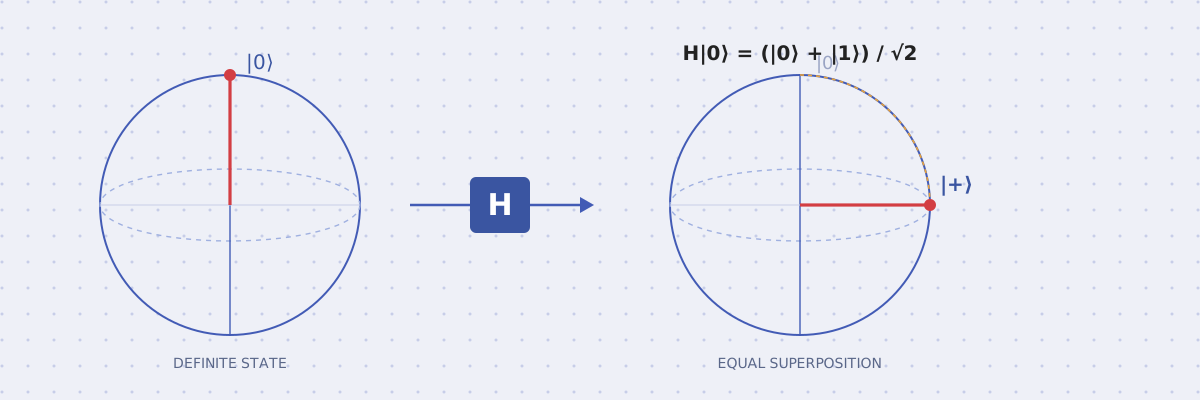
If you strip every quantum algorithm down to its first line of code, an overwhelming number of them start the same way: apply a Hadamard gate. Grover's search, quantum key distribution, the quantum Fourier transform at the heart of Shor's algorithm, most of today's NISQ-era chemistry and optimization circuits (VQE, QAOA) — all of them open by handing a qubit to the Hadamard gate before doing anything else. If the state vector is the noun of quantum computing, the Hadamard gate is very often the first verb.
What It Does
The Hadamard gate (H) is a single-qubit gate that takes a definite computational basis state and turns it into an equal superposition of both. In matrix form:
        1  [ 1   1 ]
H  =  ----- [       ]
       √2  [ 1  -1 ]
Applied to the two basis states:
H|0⟩ = (|0⟩ + |1⟩) / √2   =  |+⟩
H|1⟩ = (|0⟩ - |1⟩) / √2   =  |−⟩
Both outputs are 50/50 superpositions in measurement probability — the only difference is a relative phase (a plus or minus sign in front of the second term). That phase is invisible if you measure immediately, but it is exactly the kind of information that later interference depends on, which is why H shows up again and again inside larger circuits, not just at the start.
The Geometry: Pole to Equator
On the Bloch sphere, |0⟩ sits at the north pole and |1⟩ at the south pole. The Hadamard gate is a 180° rotation around an axis tilted halfway between the sphere's x-axis and z-axis — and the practical effect of that rotation is to swing a pole state onto the equator. The hero image above is that transformation: a definite state going in, an equal superposition coming out. Every point on the equator represents a 50/50 measurement split with a different relative phase; H|0⟩ and H|1⟩ land on opposite sides of that equator.
The Coin-Flip Analogy — And Where It Breaks
The Hadamard gate is often introduced as "flipping a coin so it lands on heads and tails at the same time." That's a fine hook, but it's worth being precise about where the analogy holds and where it doesn't. A classical coin mid-flip has an unknown but definite orientation — the uncertainty is in your knowledge, not in the coin. A qubit after a Hadamard gate has no definite value at all; the 50/50 split is a description of the physics itself, not your ignorance of it. That's the same distinction covered in the previous post, and it's what makes the superposition a resource you can compute with, rather than just noise you have to average away.
Why It's Reversible (And Why That Matters)
Apply the Hadamard gate twice and you're back where you started:
H(H|0⟩) = |0⟩
H(H|1⟩) = |1⟩
H is its own inverse (H² = I, the identity). This isn't a cute coincidence — every quantum gate must be unitary, meaning reversible and information-preserving, because the underlying physics (Schrödinger evolution) is reversible. This is a hard constraint that classical logic gates don't share: a classical AND gate destroys information (you can't recover both inputs from the output), but no quantum gate ever can. It's also why building irreversible classical operations (like measurement, or a NAND gate) inside a quantum circuit takes deliberate extra qubits and careful design — reversibility is the default you have to work within, not an optimization you opt into.
Where It Actually Gets Used
- Search and factoring: Grover's algorithm and the quantum Fourier transform inside Shor's algorithm both open with a layer of Hadamard gates across every qubit, spreading the computation's amplitude evenly across all possible inputs before interference goes to work narrowing it down.
- Quantum key distribution: Protocols like BB84 use the Hadamard gate to prepare and measure qubits in two different (mutually incompatible) bases. An eavesdropper can't measure in both bases at once without introducing detectable errors — the security proof leans directly on H's role in switching bases.
- Building entanglement: A Hadamard gate followed by a CNOT gate is the standard two-gate recipe for creating a Bell state — the subject of the last post in this series. Superposition has to exist before entanglement can be built on top of it.
- Near-term chemistry and optimization: Variational algorithms (VQE, QAOA) running on today's noisy hardware use layers of Hadamard and rotation gates to prepare trial states that are then iteratively refined by a classical optimizer.
Why This Is Harder to Engineer Than It Looks
A single Hadamard gate is mathematically trivial — a 2×2 matrix a first-year student can multiply by hand. Building one that survives contact with real hardware is not. 2026 has been the year gate fidelity crossed a genuinely important engineering line: major hardware platforms have pushed two-qubit gate error rates below the 1% threshold required for practical quantum error correction, with Google's Willow chip demonstrating error rates that improve as more physical qubits are added to a logical qubit, and IBM's error-correction-focused processors targeting a demonstrable quantum advantage on a useful workload before the end of the year. Single-qubit gates like the Hadamard are generally the easiest to get right and already run at high fidelity on most platforms — but every one of those logical, error-corrected qubits is still built by chaining together enormous numbers of physical single- and two-qubit gates exactly like this one, each of which has to be right.
Key Takeaways
- The Hadamard gate maps
|0⟩and|1⟩to equal superpositions,|+⟩and|−⟩, differing only by relative phase. - Geometrically, it's a rotation that moves a state from a pole of the Bloch sphere to its equator.
- It's unitary and self-inverse (H² = I) — a hard requirement shared by every quantum gate, not a special property of this one.
- It's the standard first step in search algorithms, factoring algorithms, quantum key distribution, and entanglement generation.
Hadamard rotates a qubit off its axis entirely. The next post covers the three gates that rotate it around an axis instead — X, Y, and Z, the Pauli gates, which turn out to be more than just single-qubit operations: they're the literal building blocks of how quantum error correction detects and fixes mistakes.