Whenever headlines mention quantum computers “breaking the internet,” the panic usually sounds binary—either everything stays safe, or every secret on Earth gets exposed overnight.
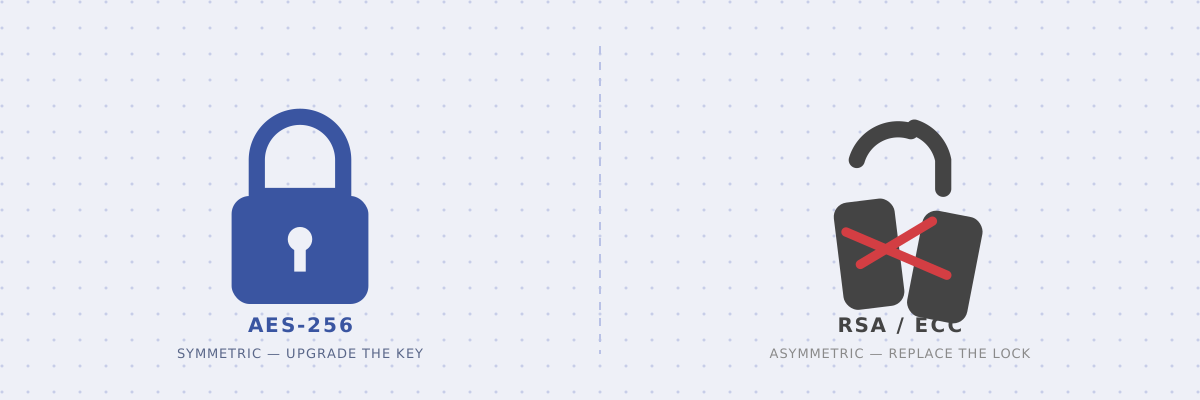
The reality is far more nuanced. Quantum computing doesn't hit all security the same way. Instead, it divides digital security straight down the middle: one half only needs a longer key, while the other faces near-total collapse unless we rebuild it from scratch.
More critically, this is not just an abstract problem for tomorrow’s physicists—it is a concrete operational risk for businesses today.
The Two Locks Protecting Your Daily Life
Every time you tap to pay, send a message, or browse a website, two different cryptographic systems work together in a tag team:
- Symmetric Encryption (The Combination Safe): Fast and powerful. Both sender and receiver share the exact same secret key. It does the heavy lifting: encrypting your phone’s storage (BitLocker or FileVault), streaming data over a VPN, or scrambling a 4K video call on WhatsApp.
- Asymmetric Encryption (The Mailbox Slot): Clever and math-heavy. Anyone can drop a message through the open slot using a public key, but only the owner holding the private key can open the back door. It handles the initial handshake: verifying that your bank’s website is authentic and securely swapping a temporary key before data starts flowing.
Lock #1: Symmetric Ciphers Face Grover’s Algorithm
In classical computing, cracking an Advanced Encryption Standard (AES) combination requires checking every single possibility—a brute-force search that would take classical supercomputers longer than the lifespan of the universe.
In 1996, computer scientist Lov Grover introduced a quantum database search algorithm. Rather than checking possibilities one at a time, it leverages quantum mechanics to search through possibilities in quadratic time (O(√N)).
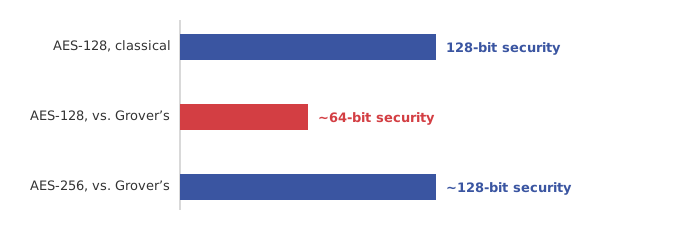
- The Impact: It effectively cuts your key length in half. A 128-bit key drops to roughly 64 bits of security—putting it dangerously close to crackable territory.
- The Fix: Double the combination length. Upgrading from AES-128 to AES-256 leaves an attacker facing 2128 operations even with a fault-tolerant quantum computer running Grover’s algorithm. The math holds; the lock simply needs a longer dial.
Lock #2: Public-Key Cryptography Faces Shor’s Algorithm
Public-key cryptography (RSA, Diffie-Hellman, and Elliptic Curve systems) relies on asymmetric math problems that are straightforward to calculate in one direction but virtually impossible to reverse—like multiplying two massive prime numbers together.
Peter Shor proved that a sufficiently large quantum computer can exploit periodic mathematical patterns to solve prime factorization and discrete logarithms in polynomial time.
- The Impact: This is not a speed boost; it is an architectural bypass. The backdoor lock on the mailbox swings completely open. Making RSA keys larger doesn’t solve the problem, because the fundamental mathematical shortcut remains viable.
- The Fix: Complete replacement. Every digital signature, identity certificate, and secure handshake protocol must migrate to new Post-Quantum Cryptography (PQC) standards—such as lattice-based algorithms—that rely on math problems quantum hardware cannot shortcut.
The Hidden Business Trap: “Harvest Now, Decrypt Later”
If cryptographically relevant quantum computers are still years away, why is quantum readiness a boardroom agenda item today?
The urgency comes down to an active adversary strategy known as Harvest Now, Decrypt Later (HNDL). Threat actors are intercepting and hoarding encrypted corporate communications, trade secrets, intellectual property, and sensitive customer data right now. They don’t need to read it today; they just need to store it until a functional quantum machine becomes available to break the asymmetric handshake retroactively.
If your data has a shelf life of 10, 20, or 30 years—such as financial records, medical archives, or national security infrastructure—its confidentiality window is already shrinking.
From Theory to Execution: The Quantum Readiness Roadmap
Waiting for quantum hardware to fully mature before upgrading is an operational trap. Replacing public-key infrastructure (PKI) is one of the most complex, multi-year migrations an enterprise can undertake. Organizations must shift from passive observation to active readiness:
- Build a Cryptographic Bill of Materials (CBOM): You cannot secure what you cannot see. Most organizations have no unified inventory of where certificates, hard-coded public keys, algorithms, and third-party dependencies reside.
- Prioritize by Data Shelf Life: Triage systems by how long the data inside them must remain secret. High-longevity sensitive data must move to post-quantum standards first to blunt the impact of HNDL attacks.
- Architect for “Crypto-Agility”: Avoid hardcoding new algorithms into your applications. Design environments so cryptographic primitives can be swapped dynamically as standards evolve and harden — NIST finalized its first three post-quantum standards (ML-KEM, ML-DSA, and SLH-DSA — FIPS 203, 204, and 205) in 2024, with a fourth, HQC, selected in 2025 as a hedge built on entirely different math.
- Audit Hardware and the Supply Chain: Post-quantum algorithms feature larger key sizes and heavier handshake overhead. Many legacy networking appliances, firewalls, and embedded OT devices will lack the memory or throughput to support them, turning PQC migration into a physical hardware refresh cycle.
Your encrypted archives aren’t evaporating tomorrow, and symmetric systems have a clean path forward: upgrade to 256-bit keys and move on. But because our asymmetric locks require replacing the entire door, the organizations that treat quantum readiness as an immediate risk management exercise will survive the transition—while those that delay will find their past secrets exposed to the future.
Want the engineering underneath this? The five-part Quantum Computing 101 series on this blog builds up from a single qubit to exactly the machinery discussed here: how quantum error correction is what actually stands between today's noisy hardware and a machine that can run Shor's algorithm at a cryptographically relevant scale, and how entanglement underpins the physics-based alternative to NIST's math-based PQC standards.