The question every AI infrastructure planner is asking is where the next several gigawatts will come from, and when they will arrive. Fusion has long been a promise in energy planning, and it has usually been described as arriving later than it was promised. What has changed recently is that fusion companies are breaking ground and reporting hardware results. Pacific Fusion’s campus in Albuquerque is a concrete example. Its scale is real, but the gap between what the campus will do and what datacenters need over the next decade is the more important story.
What is going up in Albuquerque
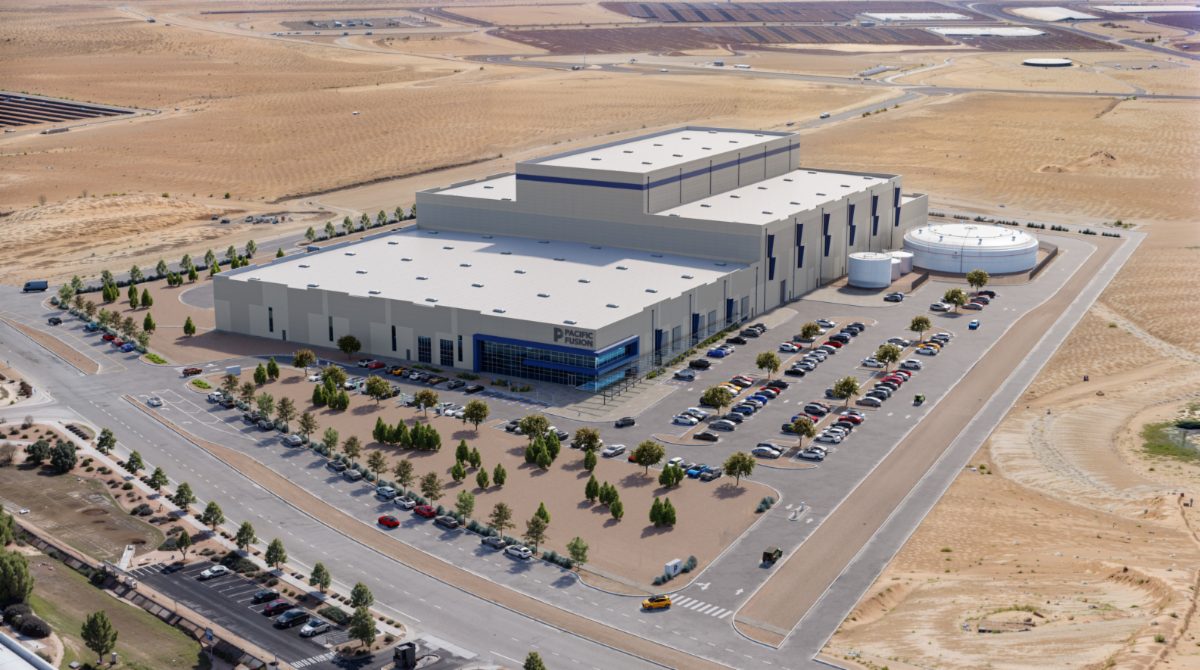
On August 25, 2026, the National Nuclear Security Administration (NNSA) and Pacific Fusion announced a Memorandum of Understanding as the company broke ground on its Research and Manufacturing Campus in Albuquerque. The campus will house the Demonstration System, which NNSA describes as “the world’s first high-yield, high-gain fusion demonstration facility designed to conduct high-energy-density (HED) and inertial fusion experiments”.
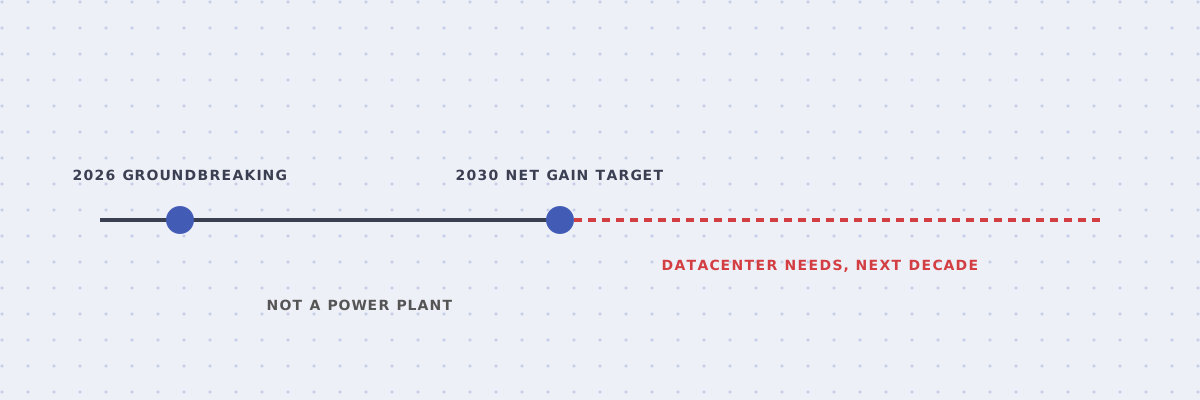
The campus is a $1 billion project of roughly 225,000 square feet at Mesa del Sol. The company is targeting a system that generates more energy than it consumes by 2030. That target is the company’s own, and it is the number to track first. The company’s site defines that target as net facility gain, meaning more fusion energy produced than the facility consumes, and calls the demonstration system a critical step toward on-demand power for the grid. The state’s economic development announcement is explicit that the facility “will not operate as a power plant”.
The MOU itself is narrower than the headlines suggest. NNSA says it is “a first step” to deepen the relationship, and that any specific projects or funding commitments are subject to separate agreements. Those future agreements are the signals to watch.
Pacific Fusion also operates a Build Center in Los Lunas, where it has hired more than 70 people and manufactures components for its fusion system. The Albuquerque campus is expected to create more than 200 permanent jobs. The facility requires about 3.3 megawatts from the Public Service Company of New Mexico, a figure that matters when we compare it with datacenter loads later in this piece. Pacific Fusion says the site’s water demand is less than other commercial buildings of a similar size.
The machine behind the campus
Pacific Fusion pursues what it calls pulser-driven inertial fusion. In this approach, fast-rising, high-current pulses magnetically squeeze and heat small containers of deuterium-tritium fuel to fusion conditions, and the process repeats. The company says its work builds on the Z Machine at Sandia National Laboratories and on the ignition result at the National Ignition Facility at Lawrence Livermore.
The most concrete hardware evidence so far is the Sirius prototype. Researchers from Lawrence Livermore and Pacific Fusion passed 3,000 shots with Sirius, a four-stage impedance-matched Marx generator of the type that can provide pulsed power to an inertial confinement fusion machine. The team called it a “key milestone in the development of high-gain fusion”. Three thousand shots show that the hardware can be run repeatedly. The reporting on that milestone does not address power output, so it says little yet about how much energy the system can deliver.
The design argument is modularity. The company describes its pulser as built from 156 identical modules, each with 32 identical stages and 10 identical bricks per stage. Its stated goal is “mass-manufacturable, modular electric pulsers”. For a datacenter planner, that is the part worth watching. A fusion plant built from identical units could in principle be scaled the way other modular infrastructure is scaled. Whether the approach works at manufacturing volume is still an open question, and the campus is the first place it will be tested.
Funding is substantial. Pacific Fusion has raised a Series A of more than $900 million, led by General Catalyst, and reports a team of more than 140 staff.
The federal policy stack
Two different policy stacks are relevant here, and they should not be blurred. The first is fusion-specific. Pacific Fusion’s own presentation argues that its regulatory environment is much simpler than fission’s because of the ADVANCE Act, passed in 2024. The company’s core technical argument is that fusion has no fissile material, no meltdown risk and no long-lived waste. That distinction is real, but the regulatory details are the company’s characterization. What the New Mexico filing does establish is that radioactive materials used at the site are regulated by the state’s Environment Department Radiation Control Bureau, which ensures they are shielded and monitored.
The second stack is broader and aimed at AI and nuclear generally. The White House’s year-one science summary describes four executive orders signed in May 2025 directing federal agencies to expedite nuclear energy production. In July 2025, the administration released America’s AI Action Plan, which it says identified over 90 federal policy actions, and issued three AI executive orders on the same day, including one to promote rapid buildout of data centers and supporting energy infrastructure.
The permitting side is where the work that affects a campus like this one happens. The Council on Environmental Quality released a Permitting Technology Action Plan on May 30, 2025, and an initial NEPA and Permitting Technology Data Standard, with version 1.2 released on August 18. The administration also launched a searchable Categorical Exclusion Explorer on June 5, 2025.
The most direct link to datacenters is siting on federal land. Between September 8 and October 31, 2025, the Department of Energy issued four Requests for Applications seeking proposals to build and power AI datacenters with nuclear or other generation at Idaho National Laboratory, Oak Ridge Reservation, Paducah Gaseous Diffusion Plant and Savannah River Site. The White House summary describes these solicitations as covering nuclear or other energy generation and does not mention fusion. That suggests the federal siting push is currently oriented toward fission and established generation, though the full solicitation texts were not reviewed for this piece. The DOE’s separate Milestone-Based Fusion Development Program selected eight companies in 2023 to develop fusion pilot plant designs.
State action is moving too. Governor Newsom signed legislation on September 30, 2026, to accelerate California’s fusion and quantum industries, following a $5 million Fusion Research and Development Innovation Initiative the state created the year before. The same announcement paired the bill with a $30 million investment aimed at quantum and deep-space research. New Mexico has also expanded its Advanced Energy Equipment Tax Credit to cover fusion machines. Germany’s SPRIND agency funds fusion companies using the same milestone-based model it applies across its portfolio, with funds awarded competitively to fusion companies, particularly start-ups.
What this means for AI datacenters over the next decade
Start with scale. The Department of Energy’s Office of Nuclear Energy notes that some reports estimate data centers could consume up to 12% of total U.S. energy production in 2028. Its own examples run from 10 megawatts to 1 gigawatt per facility, with future datacenters potentially reaching 4 gigawatts or more. Set against that, the Albuquerque campus draws about 3.3 megawatts. A single 1-gigawatt campus is roughly 300 times that load. The demonstration system is an engineering milestone, not a supply source.
The reliability requirement is just as demanding. Datacenter operators need 99.999% or better energy reliability, and the DOE notes that downtime can cost over $8 million per day by some estimates. Nuclear plants run around the clock and rarely shut down. Current plants operate 18 to 24 months at a stretch, and refueling outages typically last only a few weeks. The public material on the Albuquerque campus does not address that standard, and it is not yet clear how a fusion plant would be measured against it.
A recent preprint on nuclear power for AI computing frames the question the right way. Its authors evaluate capacity factors, levelized cost of electricity, grid interconnection constraints and deployment pathways, and conclude that the challenges and uncertainties must be weighed alongside the strengths. It is a perspective rather than a demonstration, so it frames the trade-offs without settling them.
Interconnection is where my read says the near-term risk sits. The DOE article describes the Amazon and Talen Energy deal of March 2024, a $650 million purchase of a co-located datacenter and up to 960 megawatts from the Susquehanna Steam Electric Station. The Federal Energy Regulatory Commission then put efforts to add more power “behind the meter” on hold over concerns that such deals let data centers use transmission systems without paying for them. A future fusion power purchase would likely face the same kind of scrutiny, and the DOE notes that future efforts will need to navigate this new territory.
Put together, the decade looks like this. The 2030 net-gain target, if met, would be a significant result for the demonstration system. Commercial power would still require plants, a grid connection and power contracts. My read is that a datacenter signing a fusion offtake in the late 2020s would be buying an option on power that may not arrive until later, and would need firm power from other sources in the meantime. The federal money flowing toward fission sites, the HALEU fuel supply effort that advanced reactors require and the permitting reforms all point toward fission and established generation for the near term. Fusion’s contribution to datacenter power is further out.
Fusion’s nearer-term effect on datacenters is as a signal and a supply-chain force. Pacific Fusion’s Los Lunas and Albuquerque investments are building a local workforce and component base for its own system. Its 3,000-shot prototype is evidence that pulsed-power hardware can be run repeatedly. Those are useful developments, but they are not a power supply.