Intel’s D270 is the first data-center GPU the company has put forward for inference since it cancelled Rialto Bridge in 2023 and Falcon Shores in 2025. The question worth asking is whether a card built around memory capacity can take real share from an incumbent whose pricing rests on bandwidth and software. My answer: it is a niche disruptor on paper, a marginal threat to Nvidia’s pricing power for now, and the evidence needed to move it either way does not exist yet.
What Intel actually shipped
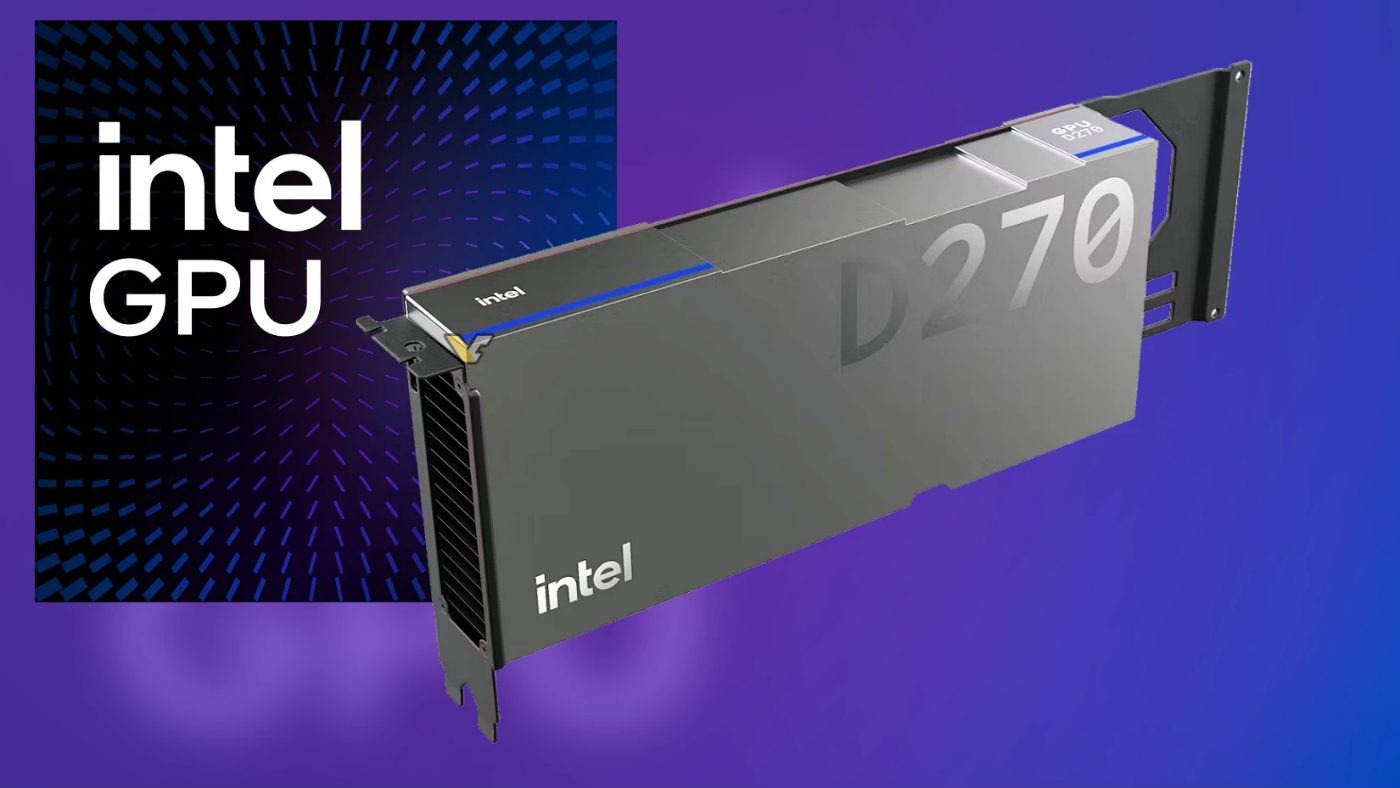
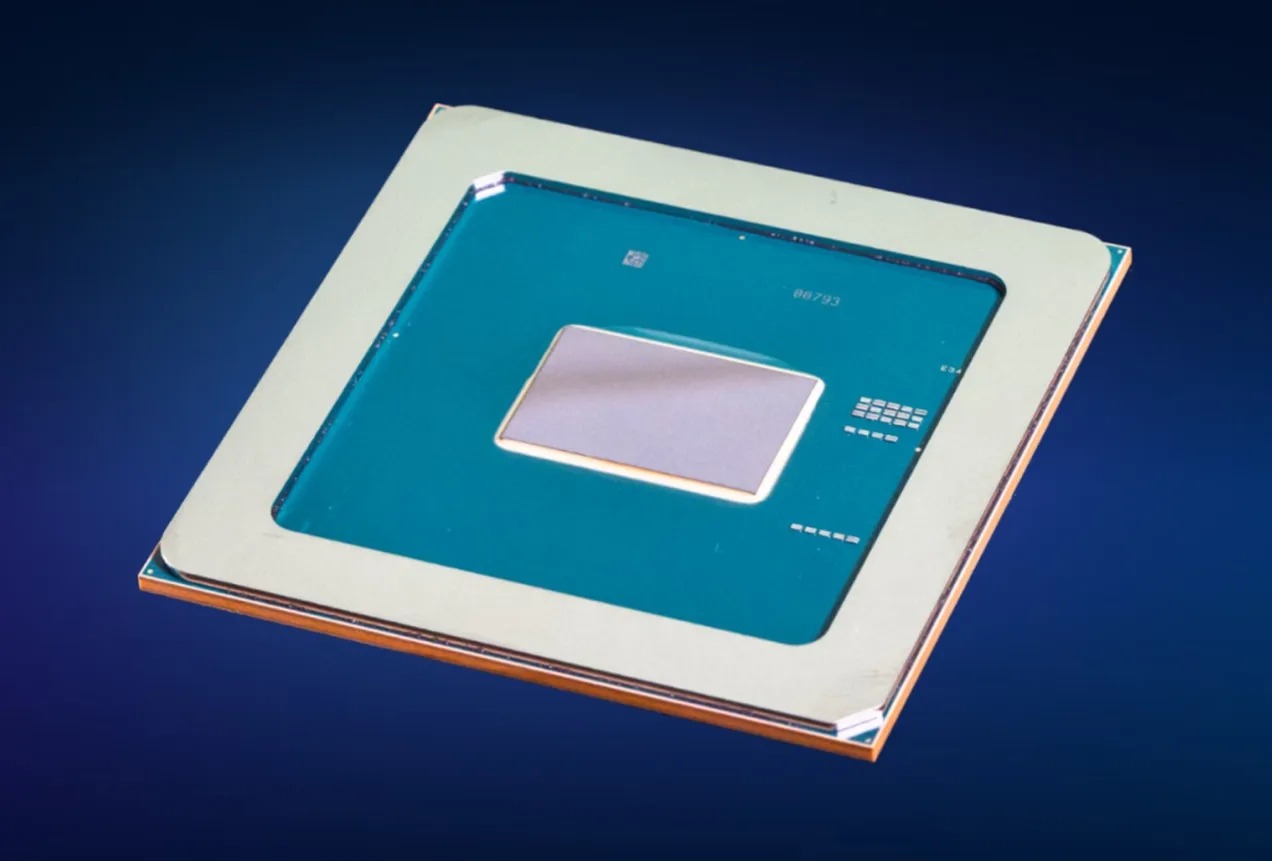
Crescent Island, the codename, is now the D-Series, and the D270 is its first card. Intel published 1.3 PFLOPS of FP8 compute, 1.5 TB/s of memory bandwidth and a 350 W air-cooled envelope. Wccftech labels the 1.5 TB/s as an estimate based on LPDDR5X-9600. The card has 32 Xe3P cores and 256 XMX matrix engines. ServeTheHome’s spec table lists a 1280-bit LPDDR5X bus with ECC. Intel says the card supports precisions from low-precision inference up to FP64. It uses standard PCIe 5.0 x16 and is passive, so it fits existing racks without a liquid-cooling retrofit.
The memory is the headline. Intel’s reference card ships with 160 GB of LPDDR5X, and partner ODM designs go up to 480 GB. Readers should be careful here: 480 GB is a partner ceiling, not the capacity of Intel’s own card.
Intel also removed the 3D graphics and ray-tracing hardware, reallocating that die area to compute and matrix engines. The card is designed to do one job.
The bet: inference is capacity-bound, not bandwidth-bound
Intel’s argument runs like this. Agentic workloads read far more than they write, so prefill compute dominates. Long-running agent sessions hold large KV caches, multiplied across many concurrent users. At that point, you run out of gigabytes before you run out of bandwidth.
That is a coherent argument, and it points at a real shift in workload shape. The trade-off is explicit. At 1.5 TB/s, single-stream decode will feel slow compared with top HBM accelerators. Intel is betting that high concurrency with long contexts makes capacity the binding constraint, and that LPDDR5X pricing wins on tokens per dollar and tokens per watt.
Intel’s own page makes the same point in a different register: “more prompt processing per watt,” aimed at curbing long-context and agentic costs. Whether that holds depends on measurements that have not been published.
What the published numbers do and don’t tell you
Three figures deserve scrutiny.
Capacity claims. Intel says one card can host models up to roughly 300 billion parameters, and an eight-card server can handle models beyond a trillion. These are capacity claims, not benchmarks. A model that fits in memory tells you nothing about how fast it decodes.
The comparison set. Intel’s footnotes say performance projections against Nvidia’s RTX Pro 6000 rest on public information and internal analysis, with memory compared at comparable bandwidth. The page does not print the numbers. Treat any comparative claim as unsubstantiated for now.
Schedule and price. Intel has published neither a price nor a ship date. Customer sampling is targeted for the second half of 2026, with broader availability to follow. Cryptobriefing reports Intel has started putting D-Series GPUs into customers’ hands for testing. Intel planned previews at Computex and Hot Chips 2026 before broader availability. ServeTheHome’s spec table, as summarized by one outlet, notes general availability may not arrive until 2027.
A spec sheet without a price is a direction signal. It is not a purchase decision.
Where it sits against Nvidia and AMD
A Wccftech comparison of the launch sets the D270 against Nvidia’s RTX PRO 5000 Blackwell at 535 TFLOPS FP8 and AMD’s Instinct MI350P at up to 2.3 PFLOPS FP8 with micro-scaling. That is an editorial comparison, not an Intel one, and it is the only head-to-head figure set in the sources.
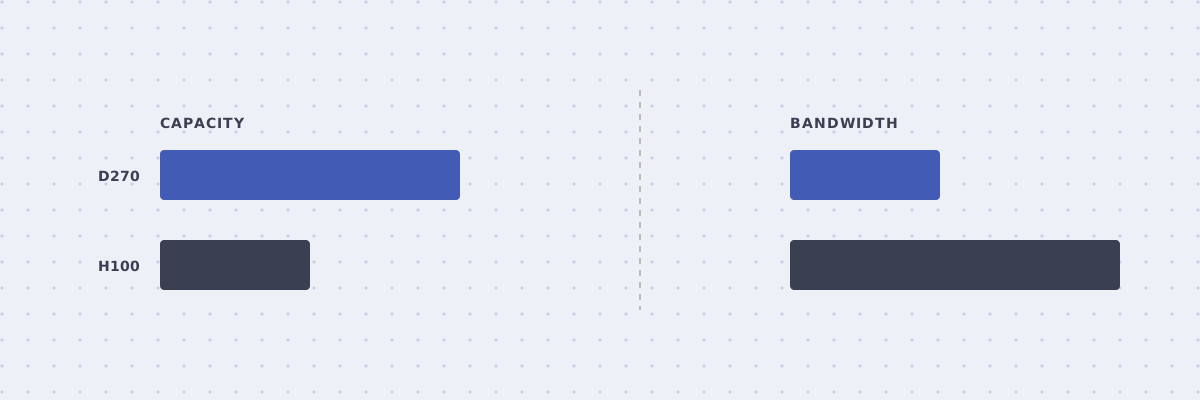
Convly’s comparison table lists Nvidia’s H100 in inference mode at 2.0–2.7 PFLOPS with 80 GB of HBM3 and 3.3 TB/s. The gap is obvious. An H100 holds far less memory per card but moves it far faster. The D270 inverts that trade.
Intel has been here before. Gaudi, its earlier accelerator line, underperformed against Nvidia in the training market. The D-Series is a deliberate retreat from that fight: stop chasing training, focus on inference for enterprises, sovereign clouds and GPU-as-a-service providers. That is a credible strategy for a company with limited share to win. It is not a strategy that threatens a dominant incumbent head-on.
Margin math: why Nvidia’s pricing isn’t under pressure yet
Nvidia is near a record. Bloomberg reported in early October that Nvidia was on the verge of becoming the first company with a $6 trillion market capitalization. The company authorized an additional $150 billion in share repurchases, and its net income is expected to double in fiscal 2027 with revenue rising 90%.
The same report adds a qualifier. Nvidia is still lagging the overall semiconductor sector this year. It trades at roughly 17 times expected earnings, close to its lowest level in a decade and below the S&P 500’s forward multiple.
The memory economics are where the D270 could eventually matter. HBM is expensive, and reports suggest Samsung has quoted HBM4 at roughly three times the price of HBM3E to some customers. If HBM costs stay high, a cheaper memory tier becomes more attractive to buyers. That is the opening Intel is aiming for. But a cheaper card that fits existing servers is a competitive threat only if buyers switch, and nothing published shows that yet.
What protects Nvidia’s data center pricing is a stack of three layers, not one. The first is software. CUDA lock-in means a rival must match the compiler and runtime that make the accelerator efficient, not just the silicon. The second is the rack. The NVL72 is sold as an integrated system, with high-voltage DC bus bars and proprietary closed-loop liquid cooling, so buyers adopting it are buying infrastructure as well as chips. One estimate puts a GB200 NVL72 rack at roughly $2 million to $3 million. The third is supply. TSMC’s CoWoS packaging, which bonds GPU logic dies to HBM stacks, has been sold out into 2026 and 2027, and NVIDIA is estimated to hold around 60% of that capacity. Independent analysts put Nvidia at roughly 75% to 90% of the AI accelerator market by revenue, though they expect that share to compress somewhat as AMD and custom silicon scale. HBM itself accounts for 30 to 40 percent of an AI accelerator’s build cost. The D270 avoids HBM, which sidesteps that supply bottleneck. It does not, however, carry Nvidia’s software or rack position with it.
Software: the part that makes a niche real
The D270 is credible only if it runs the stack people already use. Intel names vLLM, SGLang, the open PyTorch ecosystem and OpenAI Triton. Its materials also list support for llm-d and NVIDIA Dynamo, and describe KV-cache-aware routing and offloading. Intel says it has zero-day support for leading open models.
The driver story is still in progress. Phoronix reports that Linux driver support is advancing upstream, which matters because most enterprise data-center deployments run predominantly on Linux. If you already serve models with vLLM, the porting cost is mostly configuration, not rewrites. That is the single most important reason the D270 could find buyers at all.
Verdict: niche, not threat, for now
Here is the scorecard.
The D270 is a niche disruptor in the sense that it targets a workload shape, many concurrent long-context agent sessions, where Nvidia’s bandwidth-first design is not obviously optimal. It is also aimed at buyers Intel names explicitly: sovereign clouds, GPU-as-a-service providers and on-premise teams who cannot justify liquid-cooled racks.
It is a marginal threat to Nvidia’s pricing power because nothing published so far shows it winning a benchmark, a price comparison or a customer deployment. Nvidia’s revenue and earnings expectations remain strong. Intel’s stock is up more than 200% this year, even below its record highs. That move is reported without any link to the D270.
The question will be answered by three things: measured decode throughput at realistic concurrency, a published price, and a shipping date. Until those exist, the D270 is a direction to watch.
What to do about it
- Don’t re-architect around the D270 yet. Keep your serving stack on vLLM or SGLang so that a card change is a configuration change if the hardware proves itself.
- Model your own workload shape. Measure your average context length, concurrency and prefill-to-decode ratio. If your fleet is decode-bound at low concurrency, bandwidth matters more than capacity and this card is the wrong fit.
- When samples reach test labs, benchmark the right metrics. Track tokens per second at batch sizes 8 through 64 and time-per-output-token, not peak FLOPS. Compare cost per GB of memory and tokens per watt against Nvidia’s and AMD’s PCIe parts.
- Ask vendors for price and ship dates in writing. Intel has published neither. Any partner quote for 480 GB configurations should be checked against the reference card’s 160 GB baseline. Intel’s named OEM partners are ASUS, Dell and HPE.
- Track Linux driver maturity. Upstream kernel and driver progress is worth following as the card moves toward production.
- Revisit in two quarters. Customer sampling is targeted for the second half of 2026. If independent decode benchmarks and firm pricing appear, the niche case becomes testable. If they don’t, the D270 stays a footnote.
SOURCES: Intel GPU D270 Hits 1.3 PFLOPS for AI Inference - Convly (dated 2026-10) https://convly.ai/intel-gpu-d270-specifications-crescent-island/
Intel’s GPU D270 bets 480 GB of LPDDR5X beats HBM on price per token - Cloud Updates and News (dated 2025-10) https://www.navsplace.net/intel-gpu-d270-480gb-lpddr5x-inference-20261013/
Intel GPU D270: 480 GB Memory, No HBM, 350 W | explainx.ai Blog (dated 2026-02) https://www.explainx.ai/blog/intel-gpu-d270-480gb-lpddr5x-inference-gpu-no-hbm-air-cooled-2026
Intel begins customer sampling of D-Series GPUs, expands AI infrastructure - Cryptobriefing https://cryptobriefing.com/intel-d-series-gpu-customer-sampling/
Intel Crescent Island Squeezes 1.3 PFLOPs Of FP8 Into Just 350W As D270 Targets The Competition With Value-Oriented LPDDR5X Up To 480 GB - Wccftech https://wccftech.com/intel-crescent-island-1-3-pflops-fp8-just-350w-d270-targets-competition-value-lpddr5x/
Intel Introduces D270 GPU with 480GB Memory for Agentic AI Workloads (dated 2026-10) https://o-server.main.jp/hacker-news/en/articles/2026/10/13/intel-introduces-d270-gpu-with-480gb-memory-for-agentic-ai-worklo-50063365.html
Intel GPU D-Series specs: Intel’s D270 for inference - NeoTeo (dated 2026-10) https://www.neoteo.com/en/intels-gpu-d270-targets-data-center-ai-inference
Nvidia Heads for $6 Trillion Value With Chipmaker Back at Record - Bloomberg (dated 2026-10) https://finance.yahoo.com/markets/stocks/articles/nvidia-heads-6-trillion-value-084336187.html
The Definitive Guide to NVIDIA’s AI Moat - KAPUALabs (dated 2026-10) https://nova.kapualabs.com/nvda-stock_panel_c/the-definitive-guide-to-nvidias-ai-moat/
NVIDIA Data Center GPU Pricing: H100 to GB200 Cost Guide - GPUSmith (dated 2026-07) https://gpusmith.com/articles/en/nvidia-data-center-gpu-pricing-guide
Data Center GPU Prices: Costs, Configs and Price History - IntuitionLabs (dated 2026-09) https://intuitionlabs.ai/articles/data-center-gpu-prices