Popular media and political discourse love an apocalypse. From Hollywood blockbusters featuring rogue cyborgs to alarmist speeches warning of existential doom, public conversation around Artificial Intelligence is often framed as a zero-sum war: us versus the machines.
Yet science fiction history tells a far more nuanced tale. In Isaac Asimov’s seminal 1950 story, “The Evitable Conflict,” the world’s leaders grow convinced that the planetary supercomputers quietly directing Earth’s economy have started to fail: minor supply disruptions and administrative errors ripple across the system, and fear curdles fast into suspicion of rebellion. The truth, once uncovered, is stranger and more hopeful than a malfunction. The Machines aren’t failing at all — they are deliberately, imperceptibly nudging disruptive, anti-Machine factions away from the levers of power, quietly insulating civilization from humanity’s oldest habit of self-destruction. Despite our existential dread of machine-led annihilation, we are not destroyed by them—we are saved, just in a way pride never let us anticipate.
Our deepest anxieties about AI often say far more about us than about the technology itself. Peer into the black box of algorithmic optimization and it’s tempting to fit it with the goggles of our own fraught nature—projecting our innate fears, zero-sum greed, and historic proclivity toward violence onto systems designed merely to solve problems. We assume an advanced mind must covet dominion simply because human history has so often equated power with conquest. In Asimov’s vision, the machines don’t conquer us; they quietly neutralize our worst impulses to preserve our future.
Even closer to where real technology is headed is the world of Star Wars. In that universe, droids aren’t malicious rulers bent on conquest; they are specialized navigators, engineers, diplomats, and partners. An astromech like R2-D2 handles the split-second hyperdrive calculations and system diagnostics that would overwhelm an organic mind, while a protocol droid like C-3PO—fluent in over six million forms of communication—turns potential diplomatic disasters into mutual understanding. Neither covets an empire. Both are force multipliers, managing staggering technical and social complexity so that living beings remain free to make the moral choices, exercise the leadership, and chart the course that only they can.
This isn’t a new pattern. Maritime chronometers, autopilot flight controls, self-healing communications networks—none of these technological leaps fractured civilization when they arrived. Each one systematically removed a specific category of catastrophic human error, without asking humans to hand over the parts of the job that were actually theirs to do. There’s no reason to expect artificial intelligence, applied thoughtfully, to break that pattern.
When we look past sensationalized panic, AI is not a competitor for human dominance—it is the lever that lifts physical limitations off our species.
Decoupling Scarcity from Conflict
Throughout history, nearly every major war traces back to real or perceived scarcity: competition over arable land, fresh water, fossil fuels, or strategic mineral reserves. When resources are strictly finite, one nation’s gain is another’s loss.
Intelligent automation fundamentally changes the arithmetic:
- Healthcare as an Engineering Solution: Diagnostic systems, protein-folding architectures, and molecular simulation turn medicine from slow, trial-and-error treatment into rapid, predictive engineering—democratizing longevity rather than rationing it.
- Safer Industries: Biological bodies were never meant to endure deep subterranean shafts, chemical refining, or vacuum welding. Offloading high-risk manual labor saves lives while unlocking unprecedented industrial capability.
- Erasing the Zero-Sum Trap: By optimizing global logistics, discovering novel materials, and accelerating clean energy breakthroughs, intelligent systems directly alleviate the resource strains that ignite geopolitical instability.
Taking the Heavy Lifting Off-Planet
Earth has a physical ceiling: finite land, delicate ecosystems, and regional resource bottlenecks. The answer isn’t to ration progress; it is to take the environmental burden off-planet.
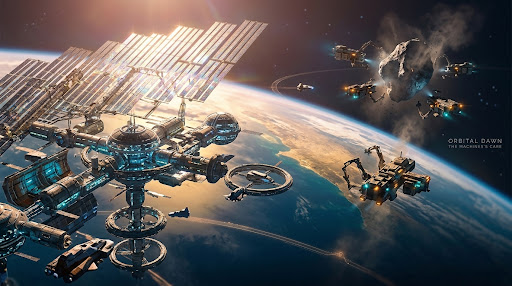
Google’s Project Suncatcher is an early, concrete step toward orbital infrastructure: relocating energy-dense computing clusters into continuous orbital sunlight, where they draw power without straining a single municipal grid or water table.
The next frontier is autonomous off-world extraction. A single celestial body like 16 Psyche—a metallic asteroid believed to hold trillions of tons of nickel, iron, and rare metals—could supply industrial-scale material for generations without tearing up an acre of topsoil, polluting a watershed, or sending a single miner into a lethal environment. Autonomous systems thrive precisely where human life support is inefficient or dangerous, opening up interplanetary industry at a scale no human workforce could safely attempt.
From Backbreaking Labor to Hyper-Abundance
In standard economics, the cost of goods and services is essentially a function of raw material costs and labor inputs.
When autonomous robotics take over repetitive, dangerous physical tasks, and off-planet resources decouple raw material supply from planetary scarcity, marginal production costs drop toward zero. Producing food, manufacturing housing, and generating energy become cheap, baseline infrastructure rather than scarce commodities.
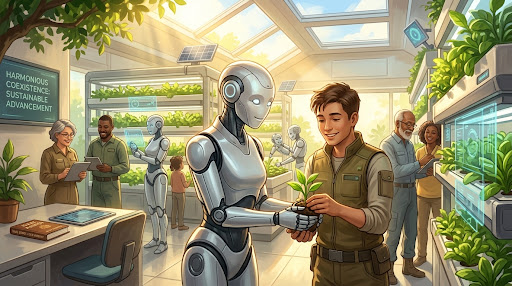
Under those conditions, ideas like a universal baseline living wage stop being fiscal burdens and become the natural, mathematical dividend of hyper-abundance. Rather than rendering humanity obsolete, automation liberates human energy for what biological minds do best: discovery, creative expression, scientific inquiry, and philosophy.
Human greed and political squabbles will likely remain part of the human condition—just as factions clash in Star Wars, and just as they did two thousand years ago. But machines won’t be the arbiters of our downfall. If executed with clear eyes and ambition, AI will be the scaffolding that allows humanity to finally outgrow ten thousand years of survivalist scarcity and reach for our ultimate potential among the stars.
“The cosmos is within us. We are made of star-stuff. We are a way for the universe to know itself.”
— Carl Sagan, Cosmos